If you're researching a new home, you've probably run into terms like production, semi-custom, custom, luxury custom and ultra-luxury custom. Builders often use these words loosely, but they describe genuinely different approaches to design, decision-making and cost.
The real differences come down to four things: how the home is designed, how much control you have over that design, the level of architectural detail, and the investment required.
A production home comes from a predetermined plan with limited choices. A semi-custom home gives you more flexibility within an existing set of plans. A fully custom home is designed from scratch for a specific homeowner and homesite. Luxury and ultra-luxury custom homes take that further, adding a higher level of architectural involvement, craftsmanship, specialized systems and personal service.
Because every builder defines these terms differently, don't rely on the label. Ask what the process actually includes.
Production vs. Custom Homes at a Glance
The ranges below are general planning numbers for Central North Carolina, meant to help you compare categories. They aren't construction quotes.
| Home Type | Typical Design Approach | General Construction Planning Range |
|---|---|---|
| Production home | Predetermined plans, limited options | $180–$250 per square foot |
| Semi-custom home | Existing plans with selected modifications | $200–$400 per square foot |
| Custom home | Individual design created for the client and lot | $300–$500 per square foot |
| Luxury custom home | Fully custom architecture, premium specifications | $500–$700+ per square foot |
| Ultra-luxury custom home | One-of-one estate design, highly specialized details | $700–$1,200+ per square foot |
General planning ranges for Central North Carolina, not construction quotes. Land and many project costs are additional.
For a broader look at the process and local investment considerations, explore our guide to custom home building in Chapel Hill.
Published North Carolina data lines up with this: standard builder-grade construction runs roughly $180–$250 per square foot, custom homes fall in the $200–$400 range, and luxury construction typically exceeds $500 per square foot statewide. In the Triangle specifically (Raleigh, Durham and Chapel Hill), the full spread runs from about $200 to $700+ per square foot depending on the project, with Chapel Hill and Pittsboro sitting at the higher end of that range due to tighter lots and stronger demand.
These ranges overlap because square footage alone doesn't set the price. Architecture, lot conditions, structural requirements, finish selections and what's actually included in the builder's number matter more.
Category 01
What Is a Production Home?
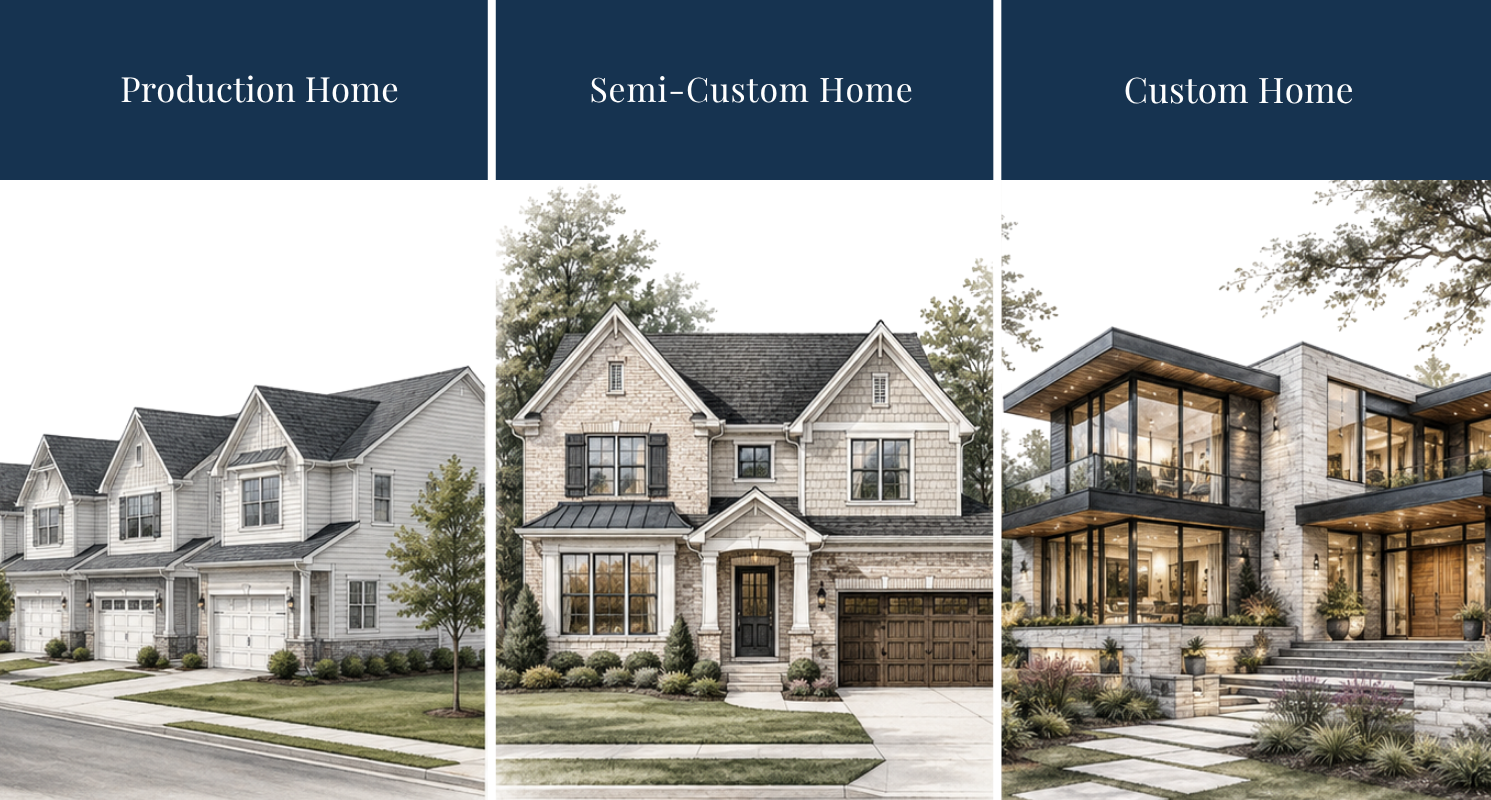
A production home is built from one of a builder's set plans, usually inside a neighborhood the builder developed or controls.
Production builders build the same handful of plans repeatedly. You might choose an exterior elevation, an interior package, a countertop color or a flooring option, but the underlying design is already locked in. The U.S. Census Bureau classifies most of these as "built for sale" homes: built on land the builder owns, with the house and lot sold together.
How they're designed
A production builder maintains a library of plans engineered to work efficiently across many lots. Structural changes are usually off the table because the construction drawings, engineering and purchasing systems are already built around each plan. Typical choices include exterior color, cabinet finish, flooring package, lighting package, an optional bonus room, or a screened porch. You're personalizing a home someone else designed, not creating a new one.
What it costs
Production construction in North Carolina generally lands around $180–$250 per square foot as a construction-equivalent figure. A 2,500-square-foot home works out to roughly $450,000–$625,000 in construction value, before the lot and other development costs.
In practice, most production homes are sold as a finished purchase price that bundles in the land, neighborhood infrastructure, builder overhead and profit, so you may never see a standalone construction number. Production builders keep costs down by buying materials in volume, reusing plans and standardizing selections.
Best for: someone who wants new construction without managing a design process: shorter timeline, an established neighborhood, fewer decisions.
Category 02
What Is a Semi-Custom Home?
A semi-custom home starts from an existing floor plan but gives you more room to change it than a production home does.
The builder typically has a library of plans that can be adjusted: moving walls, enlarging rooms, changing the exterior architecture, or picking finishes outside the standard package, depending on how flexible that builder is. This sits in the middle of the production-to-custom spectrum.
How they're designed
You start with a plan the builder has built before, then work with them on approved modifications: expanding the kitchen or primary suite, adding a bedroom or bath, reworking the upstairs layout, changing exterior materials, adding a porch or garage bay, finishing a lower level, or upgrading cabinetry and fixtures. How far you can push it depends entirely on the builder. Some allow real structural changes, others mostly offer upgraded finishes.
What it costs
In Central North Carolina, semi-custom construction generally runs $200–$400 per square foot, excluding land and certain project costs. For a 3,000-square-foot home, that's roughly $600,000–$1.2 million in early construction range.
The price climbs when you make substantial changes to the base plan. New engineering, structural modifications and premium selections can push a semi-custom project close to full-custom pricing.
Is it truly custom?
You get customization within limits the builder sets, more influence than production, but not an original design from day one. Before signing anything, ask exactly what can change, and whether the builder allows structural modifications or mostly just decorative upgrades.
Category 03
What Is a Custom Home?

A custom home is designed specifically for one client, one property and one way of living.
The process might start with a blank page, or with a concept the architect and builder develop substantially from there. Room relationships, exterior architecture, window placement and materials all get chosen around your goals. The National Association of Home Builders draws the same line: production builders work from preselected styles, while custom builders typically build on land the client already owns and start with a new design.
How they're designed
Custom design usually means early collaboration between you, the builder, the architect and the interior design team, responding to things like views and natural light, existing trees, topography, neighborhood architectural requirements, your daily routines, how you entertain, and your long-term plans. The land drives much of the design, which is why it helps to understand how to evaluate a lot before building. A home designed for a flat, wooded lot looks nothing like one designed for a steep site with long views.
What it costs
A full-custom home in Central North Carolina generally runs $300–$500 per square foot. A 3,500-square-foot custom home starts around $1.05–$1.75 million, excluding the lot and anything outside the builder's stated scope.
That budget moves with architectural complexity, the number of kitchens and bathrooms, extensive glass, custom cabinetry, or a difficult site. A smaller home can cost more per square foot than a larger one if it's packed with expensive spaces. Kitchens, bathrooms, mechanical rooms and detailed outdoor areas cost more than straightforward bedrooms or open living space.
Category 04
What Is a Luxury Custom Home?

A luxury custom home is a fully personalized residence where the architecture, construction details and interior specifications are all executed to a higher standard.
The luxury shows up in how the home is planned and built, not just what's in it. The design responds carefully to the site. Materials are chosen for appearance and longevity. The architecture, interiors and outdoor spaces are coordinated together, not bolted on separately.
Common features
Architecturally significant rooflines, expansive window and door systems, custom cabinetry and millwork, natural stone or specialty masonry, sculleries and secondary kitchens, elevators or aging-in-place planning, integrated lighting and home automation, screened living areas and outdoor kitchens, pools and detailed landscaping, high-performance mechanical systems, and specialty rooms built around how you actually live. One expensive material or appliance doesn't make a home luxurious. The strongest luxury homes feel cohesive because every detail was considered together.
What it costs
Luxury custom homes in the Chapel Hill and Pittsboro area generally run $500–$700+ per square foot, depending on the site, design and specifications. BOLD Construction's planning range for many luxury custom homes in this market falls around $500–$650+ per square foot; individual projects can land outside that range with complex architecture, extensive sitework or specialty features.
At that range, a 4,000-square-foot luxury custom home runs roughly $2.0–$2.8 million or more in construction cost. Always ask what a per-square-foot figure includes. One builder may bundle in driveways, landscaping or site prep, another may bill those separately.
Category 05
What Is an Ultra-Luxury Custom Home?
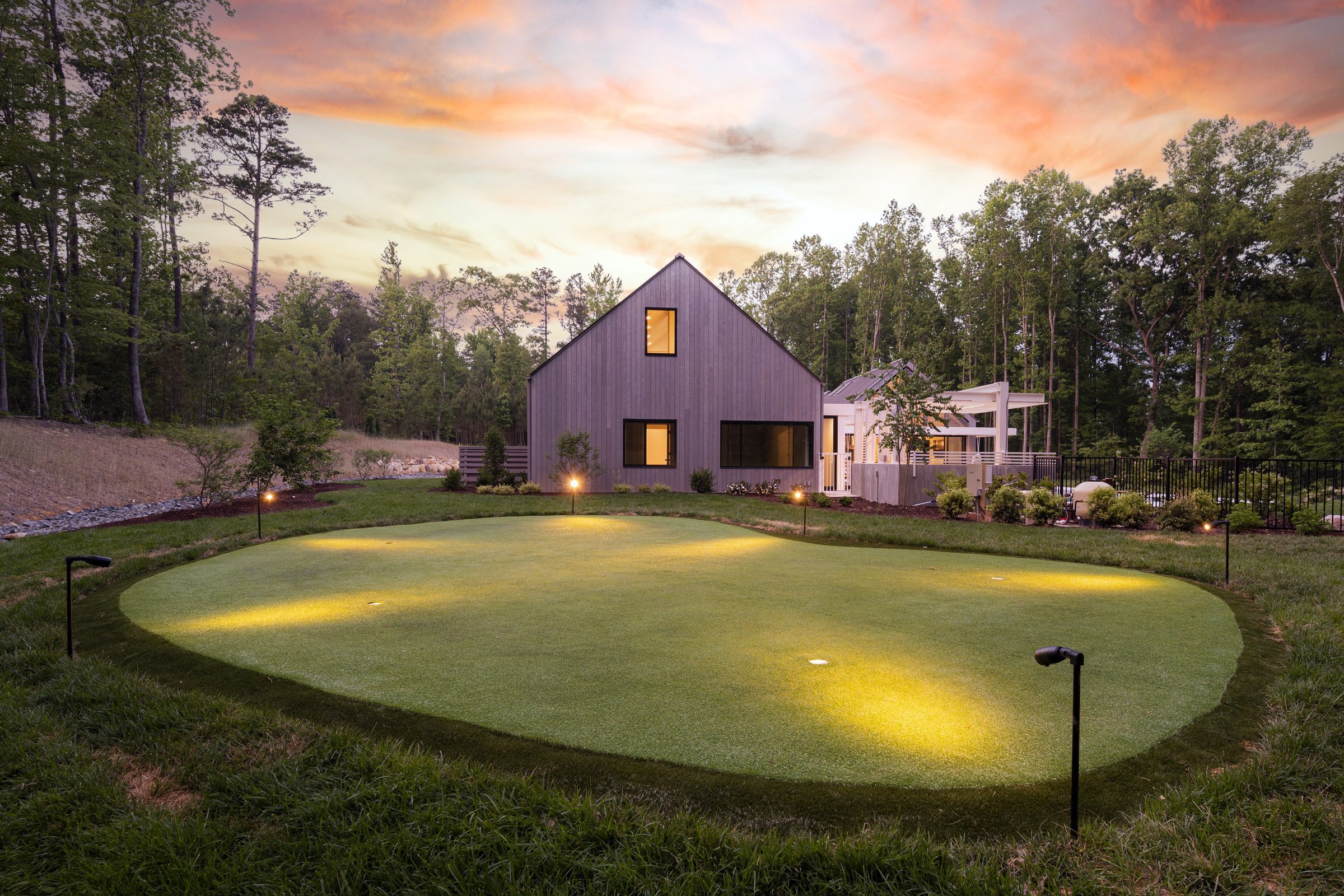
An ultra-luxury custom home is a one-of-one residence with an exceptional level of design, engineering and craftsmanship.
These are usually built for estate properties or architecturally demanding sites, often involving nationally recognized architects, specialty consultants, artisans, or materials sourced specifically for the project. Square footage alone doesn't define ultra-luxury. A carefully detailed 4,000-square-foot home can require more investment than a conventionally built 8,000-square-foot one.
What makes it ultra-luxury
Fully bespoke architecture, custom steel, bronze or specialty wood windows, handcrafted cabinetry and furniture, book-matched stone slabs, complex structural spans, curved stairs or detailed plasterwork, imported or custom-fabricated materials, hidden doors and integrated millwork, advanced lighting control, whole-home energy and backup power systems, geothermal or other specialized mechanical systems, wellness suites, saunas or cold plunges, guest houses or detached studios, and estate-scale landscaping and water features. Most of this requires custom fabrication and heavy coordination between the builder, architect, engineers and specialty trades.
What it costs
Ultra-luxury construction typically starts around $700 per square foot and can exceed $1,200 per square foot for rare materials, extensive custom fabrication or a highly complex property. A 5,000-square-foot ultra-luxury home might represent $3.5–$6 million or more, excluding land and anything outside the builder's construction scope. There's no real ceiling here. The final number tracks the ambition of the design and the craftsmanship it takes to build it.
What's Actually Included in a Custom Home Price?

Before comparing builders, get each one to define exactly what their number includes. A preliminary construction figure commonly leaves out:
- Land: the homesite purchase is usually separate from the cost of building the house.
- Site preparation: clearing, grading, rock removal, retaining walls, drainage and erosion control can move the budget significantly.
- Utilities: sewer and water connections, septic, wells, electrical service, or long utility runs.
- Professional fees: architectural design, engineering, surveys, soil studies, interior design and landscape architecture, which may or may not be in the builder's agreement.
- Permits and review fees: permitting costs, impact fees and architectural review fees vary by jurisdiction and neighborhood.
- Exterior improvements: pools, landscaping, outdoor kitchens, fencing, detached structures and long driveways.
- Furnishings: furniture, window treatments, artwork and decorative accessories.
A low cost-per-square-foot number can get a lot less competitive once those get added in. A higher number might just reflect a more complete scope. The only fair comparison is one built on the same plans, specs and inclusions.
Why Two Homes With the Same Square Footage Can Cost Very Differently

Square footage is a starting point for budgeting. It doesn't measure architectural complexity or material quality.
Take two 4,000-square-foot homes. One has a simple foundation, a restrained roofline and standard window sizes. The other sits on a steep lot with retaining walls, large structural openings, an elevator, custom cabinetry, a pool and extensive outdoor living space. Same square footage, completely different construction requirements.
That's why cost per square foot is best used as an early planning tool, not a final number. A detailed proposal based on completed plans and selections is what actually tells you what the home will cost.
Where BOLD Construction Fits
BOLD Construction is a fully custom homebuilder serving Chapel Hill, Pittsboro, Hillsborough and the surrounding areas of Chatham and Orange Counties.
We work primarily at the higher end of the custom market, from thoughtfully designed custom homes with elevated finishes up through luxury and ultra-luxury residences with complex architecture, extensive sitework and highly personalized details. Every home is designed for the individual client and property, not pulled from a library of standard plans. Investment varies with size, architecture, materials and site requirements, but every BOLD home follows a fully custom process. For luxury and ultra-luxury projects, we bring the experience to coordinate specialized systems, detailed craftsmanship and highly involved design teams.
How Do You Choose the Right Type of Builder?
It comes down to how much influence you want over the finished home.
A production builder makes sense when convenience, neighborhood availability and a streamlined process matter most. A semi-custom builder is a good fit when you like an existing plan but want more flexibility. A custom builder becomes worth it when the home needs to respond to a specific property or your layout should be built around your life. A luxury or ultra-luxury custom builder suits homeowners who place real value on original architecture, material quality, detailed execution and a highly involved building process.
Before you pick a builder, ask:
- Does the project start with an original design?
- Who owns the homesite?
- Can the floor plan and exterior architecture actually be changed?
- What level of interior design support is included?
- Which project costs are in the proposal, and which aren't?
- How are site conditions evaluated?
- When is the final construction price locked in?
- How are changes handled once construction starts?
- Who manages the project and communicates with you day to day?
The answers will tell you more than whatever category the builder puts on their homes.
Common Questions
Frequently Asked Questions
What's the difference between a production home and a custom home?
A production home comes from a predetermined set of plans, usually on land the builder controls. A custom home is designed individually for a specific homeowner and property.
What is a semi-custom home?
A semi-custom home starts with an existing builder plan that can be modified within set limits. How much flexibility you get depends on the builder.
How much does it cost to build a custom home in Chapel Hill?
Custom homes in the Chapel Hill area generally run $300 to $500+ per square foot. Luxury custom homes typically fall around $500–$650+ per square foot, and ultra-luxury projects can run well beyond that.
How much does a 4,000-square-foot luxury custom home cost?
At roughly $500–$700 per square foot, a 4,000-square-foot luxury custom home runs about $2.0–$2.8 million or more to construct. Land and other project costs are additional.
Does cost per square foot include the land?
No, generally not. It also often excludes design fees, site prep, utility connections, landscaping and other exterior improvements. Always get a written list of what's included.
What makes a custom home luxurious?
Original architecture paired with elevated materials, skilled craftsmanship and a coordinated client experience: the plans, interiors and outdoor spaces developed together rather than separately.
What's considered an ultra-luxury home?
A highly individualized, one-of-one residence involving custom fabrication, specialized building systems and an exceptional level of detail. These typically start around $700 per square foot and can exceed $1,200.
Is BOLD Construction a production or semi-custom builder?
No. BOLD is a fully custom homebuilder serving the higher end of the market. Every home is designed for the individual client and property, not selected from a standard plan library. Our work spans elevated custom homes through luxury and ultra-luxury residences.
When should I contact a custom homebuilder?
Before the architectural design is finalized, and ideally before you buy land. Early builder involvement helps evaluate site conditions, design feasibility and whether the budget lines up with what you want to build.